Saturday, August 17, 2013
My MITA Learning Journey Presentation
This is presentation of my current research I am doing for the Manaiakalani Innovative Teachers Academy. It is work in progress. This presentation is based around the Teacher as the Inquirer model.

Thursday, May 30, 2013
Comparing students digital learning progress in terms 1 and 2

At the beginning of term 1, there were not any students who could log into their netbooks without the support from other students. This might have been due to students not having a netbook during the time of being interviewed. In term 2, nine out of ten students were able to log into their netbooks independently. One out ten students could not as her parent has recently signed up for a Chrome Book and at the time of initially setting her up with her Chrome Book, we found out that we have run out of licenses. This problem is being addressed and when she is questioned in term 3, she would be able to log into her Chrome book independently.

In term 2, ten out of ten students are able to open a Google Document independently. At the start of term 1, only three students could open a Google Document independently. This goes to show that it is important to run an orientation programme for the new upcoming Year 5 students who are currently in Year 4, in learning to use Google Applications and other digital tools.

In term 2, there are ten out of ten students who know how to file their learning under the folders: Reading, Writing, Maths and Inquiry. This is an improvement, compared to term 1 where only three out ten students could do this independently. One of the variables could be that those three students could have had more practice opportunities at filing work, as their parents could signed up for netbooks / Chrome books earlier than the other students.


At the beginning of term 1 only one student could create a blog post independently. At the start of term 2, all ten students were able to do this. This is down to students having a netbook to use and having maximum practice opportunities to fulfil this requirement.


At the start of the year students did not know how to insert a photograph onto their blogs. In term two, nine out of ten students can insert photographs independently. One of the reasons for the increase is that photographs of student learning are taken regularly and are either emailed to the student or put on Picasa for the student to access.

In Term 1, children were only exposed to movie making once. They were filmed on their Inquiry Learning presentations. Each movie went through Vimeo and the embed code was emailed to them. As this was a gradual process, not all students were taught this. Also the Teacher's laptop's hard drive failed in the midst of this process and the laptop was sent away. This is a goal for term 2.

In term 1, zero out of ten students could not independently insert a photograph from Picasa onto their blogs. Three out of ten students are now able to do this independently. This could be due to that a lot of photographs were taken from my iPad and were emailed to students individually, while my laptop was being serviced. Last term students were only given 2-3 opportunities to access class photographs from Picasa.


klhjlkj

Last term, there wasn't a need for students to use their webcams on their netbooks. The webcam works well if the students were in a quiet room. It is awkward when there are other 33 students in the class. Hopefully this term students would be able to use their webcams without any uploading issues.
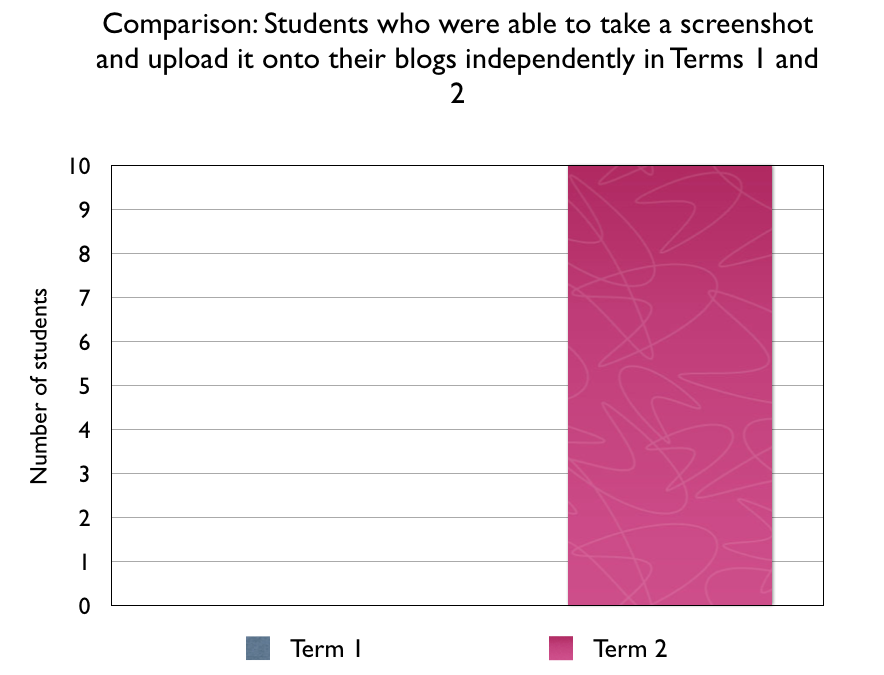
At the beginning of term 1, there weren't any students who could take a screenshot independently and upload it onto their blogs. In term 2, ten out of ten students are now able to take a screenshot and upload it onto their blogs. During the term, students have been enrolled to do online programmes such as Study Ladder, Maths Whizz and Xtra Maths. These students have been encouraged to take screen shots of their progress and to upload it onto their blogs and to write a reflective statement.

In term 1, only six students were able to comment to others. This was due to having some experience in online commenting last year. In term 2, ten out ten students were able to comment to others. This is due to students being given practice opportunities. Making comments to others is used as independent learning activity for when I am working with groups in Reading and is used as a homework task to comment on the blog of the week assembly item.

At the start of term 1, only one student was able to reflect on their own learning. Since then students have been given opportunities to critically reflect in Art, Topic and in Maths.

In term 1, the students had no experience in using hyperlinked websites. In term 2, only two students claim that they could do this independently. As a teacher, I know they have all had experience clicking on hyperlinked sites from my class site, yet this has not been emphasized to them. I feel I need to explain more to them what hyperlinking is and perhaps getting them to create a hyperlink on one of their blog posts. Seeing is believing and there's nothing like breaking the language down for them.

At the start of term 1, there were not any students who had experience using Wall wisher, Popplet and Lucid charts. Therefore they could not use these applications independently. At the start of term 2, only four students could use Popplet, Wallwisher and Lucid charts independently. More work needs to be done in this area. When these web 2.0 tools were demonstrated in term 1, not all of these students had signed up to their netbooks or Chrome Books which delayed learning. If they were to use the class computers they would then be grouped and normally one person within the group would take over the learning leaving the other member with very little hands on learning.

At the start of term 1, there weren't any students who could access the class site. Through showing the class where to go, nine out ten students are able to access the class site. The class site is being used more and more, for students to access reading follow up work, maths links, reflection activities and homework tasks.

In term 1, there were not any students who could use Google search engines. In term 2, only two students were able to use Google search engines. There are many variables to this. I think the main variable is that I tend to create hyperlinked pages for students to access specific web sites on my class site. My reason for this is that I want students to be able to access content which they would be able to read and understand. Last term, we studied war and conflict. If I got my class to search World War 1, they would find content that would be above their understanding. This would lose a lot of class time and the internet is so broad that it would like giving my children a million books to look at on this subject.


In the beginning of term one there were not any students who could check their emails independently. In term 2, nine out ten students could check their emails independently. During this last term, students have had Maths Whizz progress photographs emailed to them, Maths photos emailed to them and art photo's emailed to them. Students have had plenty of practice opportunities to access their emails and to upload email content onto their blogs.

This was a very interesting response I got from the students. Eight of ten students watched You Tube videos independently, yet in term 2 only three of ten watched You Tube videos independently. Obviously there is a decline of You Tube watchers in the Year 5 group. This could be due to the students being exposed to other forms of digital learning such as blogs, Google Apps and other Web 2.0 tools that they are focused on these tools. Also they have had the legalities explained to them about creating accounts for social network sites.

This is still work in progress. In term 1, I wanted the students to concentrate on using Google Apps and Blogger successfully. I can see You Tube videos would have a lot of potential at the end of a student presentation or in a Popplet in presentation. This can be taught later in the year.

In term 1, one out ten students were able to search and save Google images successfully. In term 2, five out of ten students were able to do this. One of the reasons for the increased number was that back in term 1, the students had the opportunity to make a presentation on a chosen war and conflict. As part of their learning they had to find legal images that they could save and upload onto their presentation. Five students within this group could not do this independently and had to rely off the Manaiakalani Teacher Aide and Year 6 students to help them throughout this process.

More work needs to be done in this area. It is work in progress. At present students are learning about Smart Media and Smart Footprints. Lessons and awareness clips are on the class site. Hopefully by term 3, there would be an increase of students who know to be a Cyber Smart Learner and would have knowledge in this area.

In Term 1, only three out of ten students know how to care for their Netbooks / Chrome Books. In term 2, nine out ten students knew how to care for their netbooks independently. This might be due to having parents going through the parent training and for eligible students to take their netbooks home. Also I spend time going over ways students need to care for their netbook / chromebooks and go over conditions around repairs, warranties and insurance matters.
Sunday, May 12, 2013
Manaiakalani Innovative Teachers Academy 2013 Project
Manaiakalani Innovative Teachers Academy Project
Research Question

What difference can I make when children at Year 5 level enter a 1:1 digital learning environment and what skills are developed over time?
What are you going to do? I will be using a semi structured interview process.
I will be using a checklist to measure the skills the children currently have. I am going
to this this in Google forms as I can compare responses made by the
target group over time. I will be gathering data and analysing data each
term. The same questions will be asked. Probing will be used to explore
the children’s thinking.
How are you going to measure it?
As a teacher I will be analysing their responses and will be implementing their needs into my planning. An example could be modelling to the class inserting a photo onto the blog, or making a comment onto someone else’s blog. The Google class site (Time table tab-weekly planning) will be used as evidence.
Having a day / week’s focus on a specific need.
The evidence will definitely be on the student blogs-hyperlinking the blogs into my analysis
Also taking screenshots of their progress, using the Teacher Dashboard.
Filming lessons which focus on needs
Interviewing students at the end of every term, to compare whether differences have been made
Using Google Forms (checklist type questions) to compare student responses over time.
Loading...
Response Summary
Click here to see the responsesAs a teacher I will be analysing their responses and will be implementing their needs into my planning. An example could be modelling to the class inserting a photo onto the blog, or making a comment onto someone else’s blog. The Google class site (Time table tab-weekly planning) will be used as evidence.
Having a day / week’s focus on a specific need.
The evidence will definitely be on the student blogs-hyperlinking the blogs into my analysis
Also taking screenshots of their progress, using the Teacher Dashboard.
Filming lessons which focus on needs
Interviewing students at the end of every term, to compare whether differences have been made
Using Google Forms (checklist type questions) to compare student responses over time.
Background Information:
In Week 3 of term 1, I interviewed ten students who were new to using netbooks and to digital learning. Eight out of the ten students started at Panmure Bridge School since they were five year olds. Two of the students came from another school within the cluster. My aim of the interview was to investigate the prior E-Learning / Digital experience these students had last year, their roles and responsibilities if they had any, the management of the class blog, learning opportunities to give online feedback and the specific skills they had / needed to know to become successful digital learners at Year 5 level.
Nine questions were asked to these students.
1. What experience have you had with E-Learning in your class last year?
The results show that the class computers were mainly used for word processing, mainly typing of work that would go onto the class blog. Some of the work came from Written Language where students would type out and publish recounts and narratives onto their class blog. Study Ladder and Maths games were used in class. Writing was also saved onto the desktop of the class computer.
2. How often were the class computers used?
There was a mixed response to this question. In this class, the amount of computer time was inconsistent and would not be regular for these students. Three students said that they would go onto the class computers once a week. Some of the responses were: 2 hours a week, sometimes when I finish my writing I would publish my work onto the class blog, every day for ten minutes, a few times a week.
3. Did you have any roles / responsibilities?
One of the students (Thomas) was the E-Learning monitor for his class last year. Thomas was asked by the Teacher to help edit other students' work before it was published online. Thomas is a highly capable student, who has excellent leadership potential. Two of the students interviewed acknowledged Thomas' role. The rest of the group said that they did not have any roles or responsibilities with monitoring the class computers last year.
4. Who managed the class blog?
The class teacher was the person students saw who managed the class blog. It was the teacher who would decide what content would go up. Two of the interviewed students said the username and password was either given to Thomas to type in and create new posts or it was displayed up onto the wall for others to type in to access the blog. Students would type their work onto a new post which would have been created by Thomas or the by the Teacher. Two of the students who came from another school within the cluster said they had no experience with blogging in their class last year. It was the Teacher students believed did most of the work and decided the content on the work that goes up onto the blog.
5. Did you have any opportunities to give online feedback?
There was a mixed response to this question. Five out of the ten students were given opportunities to give online feedback. The online feedback entailed making comments on the class blog.
Three out of the five students would go on individually to make blog comments, while the other two students would make comments in a small group. The other five out of ten students were not given opportunities to give online feedback.
6. How were the classroom computers used last year?
It was common for the classroom computers last year to be used for typing and drawing by the majority (6/10) of the group. Kid Pix was a common programme to use within the group. A minority of the group 3/10 students stated their classroom computers were used for gaming purposes. This would be either in the morning or during Maths time.
Summary:
It appears that the E-Learning experiences varied amongst the students interviewed. Some of the students had greater time on the class computers and would be given opportunities to make online comments. The E-Learning programme mainly entailed typing, drawing and playing games. This was done independently where students were expected to complete task like activities. There was no evidence of the pedagogy: Learn, Create, Share. The ownership of the class blog was very much teacher directed.
It was common that if students had finished their writing in their books they would go onto the class computers to type out their work onto a newly created post made by the teacher or by Thomas. It was more of a selected group that would have this type experience. It was clearly evident that Thomas had greater opportunities to explore and learn new skills through his role as an E-Learning monitor.
There is a need for all students to be given the same experiences and opportunities to be digital learners at this year level.Valuable E-Learning experiences need to be taught to the whole class so that all students can take part in activities given.
The next set of questions were skill based questions. As the classroom teacher of this new group of students I wanted to examine: What technical skills these students would be bringing into the classroom.
As I'm into my third year as a netbook teacher, I knew from my own teaching and experiences the desired skills that were needed to be a successful digital learner in Room 5.
I created a checklist so that I could tick off the skills the students could independently do on their own, without the support from others.
The Checklist entailed these questions:
Can you independently without the support from others:
Sign into your Google Account (6)
Open a Google Document (3)
File your work under: Reading, Writing, Maths, Inquiry (2)
Share work with others (0)
Use Google Spreadsheets (0)
Use Google Draw (0)
Use Google Presentations (0)
Insert / embed presentations onto your blog (0)
Log onto your blog (2)
Fill out the post requirements (0)
Create a new blog post (1)
Insert a photograph onto your blog post (2)
Insert a movie onto your blog post (0)
Insert a photograph from Picasa (0)
Download a photograph and upload it onto your blog (0)
Use a webcam to make a movie (0)
Take a screenshot and upload it onto your blog (0)
Comment to others on their blogs (7)
Write reflections on your learning (1)
Make a copy of a Google Document and label it correctly (0)
Click on Hyper links which take you to websites (0)
Use Web 2.0 applications such as Popplet, Lucid Charts (0)
Access the class site (0)
Use Google Search Engines (6)
Put content from the web into your own words (1)
Locate your own individual blog at home / anywhere (1)
Visited the class blog (6)
Check your emails (0)
Watched You Tube videos (8)
Embed You Tube videos into your own work (0)
Search for Google images and save them correctly (1)
Do you know what it means to be a Cyber Smart Learner (2)
Do you know how to care for your Netbook (3)
None of the above (0)
The common skills that the children were familiar with are: Signing into a Google Account, Opening a Google Account, visiting the class blog, and watching you tube videos.
One of the contributing factors as to why students were able to sign into a Google Account was that the accounts were set up last year. The entire class worked with me in logging into their Google Accounts and Creating a Google Document. They were then shown how to file their work under the files: Reading, Writing, Maths and Inquiry. Eight out of ten students were able to access and watch You Tube videos independently. This is quite alarming and this could be down to a number of variables such as: the older siblings have You Tube accounts, parents and guardians watch you tube videos, peer pressure, trends etc. Seven students were able to make comments independently. It is interesting as five out of ten students were able to make blog comments in class, yet seven students claim they are able to comment independently without support. Two out of those seven students might have computers at home which they can go on to reinforce online commenting.
The common needs of this group are:
Using Google Applications - Spreadsheets, Presentations, Draw, Sharing work with others,
Blogging: Logging into a blog, Creating new posts, filling out the required areas, inserting photographs, inserting movies, inserting Picasa and Internet images onto the blog, taking screenshots,
Using Web 2.0 Applications:
Summary:
The ten students who have entered into my classroom have minimal technical skills. This is to be expected as you don't know what you don't know. The checklist areas are new terminology for the students and they may never have come across it. The majority of the students can access their Google Accounts. This was due to me taking a Manaiakalani Release Day last year and working with the class to ensure that the students were able to log into their accounts. During the lesson the students were shown how to create a Google Document and how to file it.
Where to from here?
On Friday April 12th, I decided to interview my Year 6 students who were taught as Year 5 students by me last year. I wanted to examine the prior knowledge and skills of these students before they got their netbooks and what skills they needed to become a really successful netbook learners in Room 5. I also wanted them to identify what we / I could do better with equipping the students to be digital learners in Year 4 so that it would also be a smooth transition for them when they reach Year 5. I also wanted them to make suggestion on what they would like to know / learn on their netbook.
Five questions were asked to these students:
When you got your netbook last year was there anything you knew what to do?
Only about three of the students answered this question.
Some of the students within the group were able to get onto the internet. Most of the Year 6's had experiences using the software programme called Comic Life to create posters on topics. One of the students was able to get onto the internet and to do research. She was familiar with using the website Wikipaedia.
Did you learn this at home / school?
It was a mixed response from the group.
Half of the group were able to learn these skills at home, as they had computers at home while the other half of the group learnt the skills at school. When prompted about the skills that were taught to them at school, members of the group learnt to save work onto the hard drive and server, as well being taught to Comic Life at school.
What things do you need to know to be really successful netbook learners in Room 5? What do you need to know?
There were four common themes that were identified by these students on what they thought they needed to know to become really successful netbook learners.
These themes fitted under:
Google Apps
Blogging
Web 2.0 applications
Cyber Safety
Google Apps consisted of:- learning how to get onto Google Drive, using Google Presentations, Google Draw, knowing where to go to get the documents, make copies, accessing the class site, knowing how to log into Google Apps to access email, sharing work with others so you can give each other feedback.
Blogging: Logging into the blog, how to create new blog posts, editing, title, label posts, publish posts. Taking screenshots and uploading them onto a blog, using Picasa images and learning how to rotate pictures so that they can easily be uploaded onto the blog, learning about about embedding codes under HTML and changing sizing if needed.
Web 2.0: Learning to use Popplet and Wordle were the two examples given. Learning how to share and accessing the embed code, so that it can be copied and inserted under the HTML tab in the blog post.
Cyber Safety: Understanding the legalities of age to join sites such as You Tube, Face Book. Learning about legalities of downloading music, movies, installing games and using images (Creative Commons). Understanding who owns the email addresses: the student or the school.
What could we do better?
Legalities
Teaching us about the legalities sooner, rather than waiting for the need to arise. Teacher to track history more often. Understanding the legal ages for joining such sites as: Facebook, You Tube, Pinterest, Twitter, etc. More awareness around being a safe digital learner.
Sharing of knowledge-student mentors.
Students sharing their knowledge to new people on the computers. Sharing our individual blogs and showing our work to people. Telling them how to do it, how to publish work, telling them not to go on inappropriate sites. To make an orientation video for new users to Netbooks and Chrome books.
What would you like to know / learn using your netbook?
The students interviewed would like to use Comic Life and Kid Pix equivalents on their netbooks. The students would like to explore the Chrome Store more. To learn to use the Webcam more and to use apps that promote the use of the webcam more.
Saturday, November 13, 2010
University Seminar presentation
As part of my University paper on New Teacher Development, we had to do a seminar presentation. My topic I chose was on "How do I support a new teacher to become an independent user and integrator of technology?".
Friday, September 10, 2010
Professional Identity Assignment
This is the second assignment for my New Teacher Development course. The focus is on Professional Identity and how this is reshaped over and over again through the situations we face.
Professional Identity is shaped upon a person’s beliefs, values, motives and experiences that they bring into their daily lives. Professional identity is forever changing, re-shaped depending upon the circumstances and situations we face. Flores & Day (2005) defines professional identity as an ongoing dynamic process which entails the making sense and (re)interpretation of one’s own values and experiences that may be influenced by personal, social and cognitive factors (Flores & Day cited in Beauchamp & Thomas 2009, p 177). Professional identity can be referred to using the metaphor of chorus voices; it consists of multi-voiced and dialogical self” (Hermans & Kempen, 1993; Herman, 2003 cited in Vloet & van Swet 2010, p. 151).
Throughout my career, my professional identity has been re-shaped many times. This occurred more when I was a beginning teacher.
Contextual Constraints that impact on and affect my practice as a Teacher
There are many contextual constraints that impact on and affect my practice as a teacher. This year, the Ministry of Education introduced National Standards. This has caused a lot of public debate. It has made teachers, principals and schools’ accountable for student achievement. National Standards have impacted on the way we assess students, analyse results and report back to parents.
The barriers I face with National Standards as a teacher, is ensuring that all my children reach national expectations by the end of the year. I teach 24 year 2 students in a decile 1 school. In Reading my class is to reach Turquoise (Level 18), in Written Language my children are to reach 1 Advanced (1A) and in Maths, the expectation is for the children to be working at Stage 4 –Advanced Counting level by the end of the year. As a professional, I do not mind setting high standards, expectations and targets for my class to reach. It certainly promotes creative and innovative teaching. The problems lie with the children especially if they are truant, transient, special needs, ESOL (English for Speakers of Other Languages) and are already below the Year 0-1 national standard expectations. It does put pressure on teachers as not everyone progresses the same time as everyone else. There are always going to be the late bloomers in the classroom and not everyone has equal opportunities as background factors can have a massive influence on a child’s education.
Another constraint I face is the lack of parental support towards their child’s learning. This year I had two thirds of my parents turn up to the parent teacher interviews. The one third of the parents that did not turn up to the evening, most of them have children performing below the expected level.
Another sad factor is when you send reading and spelling homework home and it does not get reinforced. This is a real concern.
In these cases I feel National Standards do not give these children or teachers any justice. As an experienced teacher, there is a lot of professional uncertainty and vulnerability with the implementation of National Standards especially with the unrealistic expectations made by policy makers for some of the children we teach (Flores & Day, 2006). As educators, we do not know what will come next from the policy makers and whether this will influence such things as performance pay, lead tables etc.
When I first started teaching I never expected this grim reality to occur. In reference to the Flores and Day (2006) model I feel my past experiences influences of having supportive parents and where education was highly regarded mismatch the reality of the classroom context.
The current school assessment practices are contextual constraints and they do form a part in shaping my professional identity. At the moment, we have a clear file portfolio, which gets taken home twice a year. The portfolio contains samples of student work. I believe these work samples tend be snapshots and busy work. This portfolio increases the workload for teachers, as work has to go in a particular order and teachers end up filing papers into the portfolio. Questions are: How is this going to make me a better teacher? What sort of learning goes on for these children? According to Day, Kingston, Stobart and Sammons (2006) “Identity will be affected by external (policy) and internal (organisational) and personal experiences past and present, and so this may not always be stable” (p. 610). In a way I am doing something which fits under contexts of teaching and school culture, yet my beliefs of this reporting method do not match.
At the same time, we also have class blogs, which are a type of Electronic Portfolio (E-Portfolio). The blog, is a display area for students work which comes in the form of podcasts, movies, voice threads, photos. The class blogs are public and are accessible 24 hours a day, 7 days a week. Parents can leave comments on their child’s work anytime.
As a teacher I would like to see the removal of the current clear file portfolio. I would like to see the class blogs developed further and for every child to have their own E-Portfolio. This contextual constraint relates well to the Flores & Day (2006) model as my past beliefs of observing other effective forms of reporting and taking part in formative assessment professional development on purposeful learning at previous schools have influenced the contexts of teaching at my current school.
Identify some key experiences that have been significant in defining you as a professional and that have helped you understand yourself as a professional.
There are many key experiences that have been significant in defining me as a professional, and that have helped me understand myself as a professional.
Parent / Teacher interviews have been significant in defining me into the professional and have helped me understand myself as a professional. I have worked in many dynamic classes, where the behaviour and learning needs were wide. Parent / Teacher interviews test a teachers level of professionalism, especially if the child has major behavioural problems. As a teacher, you want to be honest and tell those parents about their child’s behaviour but it also needs to be done diplomatically, so that there aren’t any repercussions afterwards. In my second year of teaching, I was given the lowest ability years 3 & 4 children. At the interviews, it tested out my honesty. I could not gloss over and say to parents that their child is doing well academically if I knew that they were below everyone else. Yet as a teacher you also had to stay positive for that child and highlight that they were making baby steps with their achievement. These Parent / Teacher interviews were one of the hardest things to do. Flores & Day (2006) states “Teaching involves daily intensive and extensive use of both emotional labour e.g. smiling on the outside whilst feeling anything but happy on the inside” (p. 221).
Another experience I faced was in my first year of teaching. One of my children came up to me and said “Miss Paton, Kaira threw a stone into my yoghurt”. At the time I was busy dealing with another behavioural child. I said to the child, “I will deal with your problem later”. Later came and I totally forgot about it. The child went home and told her father. The father was very irate and went to school the next morning. It was very embarrassing. One of the lessons I’ve learnt is to take all children’s complaints seriously. The pastoral role is very demanding and requires a lot of time. Time, in which I didn’t realize until I had my own class (Flores & Day, 2006). This experience reshaped my identity because I realized afterwards that it was my role to listen to the children and to act upon any concerns. My Pre-teaching image was of a teacher that only focused only on teaching and learning, yet the role of teaching is a lot more complex than this.
When I first started teaching, I made the assumption that every child will like me, because I was young. As a Beginning Teacher, I pictured myself standing in front of a group of attentive students presenting information, going over problems and giving explanations (Ball,1988 cited in Feiman Nemser 2001). This image was not the case and it contradicted the reality of classroom teaching. According to Bartell (1995) “Teachers are never fully prepared for classroom realities and for responsibilities associated with meeting the needs of a rapidly growing, increasingly diverse student population” (Bartell 1995, cited in Feiman Nemser, 2001, p 1026). In a way, I was not prepared for what I was expecting. My class were challenging and their backgrounds were different from my own. When children did not listen, I would yell at them. At the time, I tended to think that if I were loud enough, staff and parents would think that I was a good teacher. It wasn’t until I shifted schools I realized that relationships were critical. I learnt that I needed to change and to earn the children’s respect. This experience has defined me to be the professional and has helped made me understand myself to be a professional.
Field Trips outside the classroom have been significant in defining me as a professional and have helped me understand myself as a professional.
On a field trip you learn so much about yourself and the children. These practical experiences are lessons that are not taught at University or on practicum, in a way you are thrown into the deep end. There is so much to take into consideration. Pupil safety is the main priority. On a field trip, it’s about paying attention to the students’ needs, and at the same time, trying to improve their knowledge and skills. The teacher has multiple roles on field trips such as being the guide, facilitator, educator and the overall supervisor to the children and parents (Flores and Day, 2006). As a teacher, you need to be highly organized and be much more aware of the childrens’ medical problems, physical needs e.g. toilets, student behaviour, hazards on the trip, emergency protocols, time tables and members of the public. In the back of your mind, you need to be one step ahead in dealing with situations that may occur on the day. How we handle those unpredictable situations, shape us to be professionals and these types of experiences have helped me understand myself as a professional. I have learnt that field trips are not just a fun day for the teacher, and it is a time where you take your role / image as a teacher seriously as you are accountable for what happens to the children.
To what extent, do the stages of teaching help you make sense of your own development?
The Flores & Day (2006) and the Maynard & Furlong (1993) models have made me understand the stages I went through as a beginning teacher eight years ago. The models have definitely made me reflect on the transition into teaching. I believe the Flores & Day model helps make sense of my own development to a certain extent, however I feel the model is more applicable for beginning teachers. As an experienced teacher I can relate to parts of the model, especially past influences and contexts of teaching.
My past experiences of being a child who was excluded from school productions due to having a speech language problem have shaped the way I teach my own class of children. I will always have the belief that all children need to be included. My negative experiences of primary school have reshaped my classroom practice. Pieces of my primary school days/past are ingrained into my practice. Through observing my past teachers, this has assisted in constructing my own identity. Lortie (1975) identifies this as the apprenticeship of observation (Lortie, 1975 cited in Flores and Day 2006).
Flores and Day (2006) model could be applied to these situations: shifting school and the appointment of a new principal. An example of this could be having these fantastic ideas about how you’re going to run your new classroom and then when you get there you, you are told by school leaders, that is not how we do things at this school. From there, your professional identity is reshaped again due to school culture. A new principal could bring a lot of change, which may impact on the school culture and how things are done. A new principal can impact on the reshaping of professional identity.
Maynard and Furlong’s (1993) model has helped me understand myself during my Beginning Teacher years. I went through similar stages of development as highlighted by Maynard and Furlong, however it wasn’t a linear process. At times I went back and forth through the stages, depending upon the situations I faced. These stages have contributed towards shaping my professional identity. Maynard and Furlong (1993) have identified five stages during pre-service development:
Early idealism, Survival, Performance, Consolidation and Moving on.
During the Early idealism stage I went through the period of wanting to be liked by everyone and tended to use my past experiences of being a student to influence my teaching practise. The survival stage played a critical role. I wanted to be seen as the teacher and to be in control. This was reflected in my behaviour management. Fitting into the school culture and the contexts of teaching were priorities.
The performance stage related well to my school’s behaviour management system. I tried to follow it, but didn’t understand it. During observations / appraisals I tended to focus on myself and levels of personal performance rather than on student learning. During the consolidation stage I was starting to gain confidence, yet I tended to stay within my comfort zone. The moving on stage challenged my pedagogical practice. When I shifted schools my teaching practice was refined. There was less of a focus on me and more focus on student learning and engagement. I took more of an active role within the school e.g. ICT Leader.
Do contextual factors seem to be of greater significance in your personal professional development?
The Ministry of Education’s National Standards will play a huge significance to my professional development. It is all very new to teachers and is at its early stages. There has been no trail period and schools have been thrown into the deep end. According to Feiman Nemser (2001) “Policies can improve only if the people in them are armed with the knowledge, skills and supports they need” (p. 1013)
I believe there is a real lack of knowledge, with National Standards. To me, it’s like this massive road map but no one knows which direction / path to take.
Professional Project.
In Assignment 1, I wrote that I would like to support new teachers in using technologies. Technology is widely used at my school for administration, teaching and learning purposes. These are very broad areas and would take longer than the six weeks to implement them. Upon reflection I have decided to focus on one area, which is supporting new teachers with integrating technology into their class programme.
My school is heavily involved with E-Learning and is part of the Manaiakalani Cluster, which is an E-Learning initiative. The purpose of this cluster is to raise student achievement in literacy by using E-Learning as a hook to motivate and engage students. Each class has a blog in which all students’ literacy learning is posted onto the blog. As part of the literacy learning, all classes work through a literacy cycle, which highlights the process in which the teachers and students work through.
This week a new teacher named Bob has started at my school. His class already has a blog. Bob has not worked in the cluster before. At present the lead teacher (myself) and the teachers are the administrators for their class blogs. They are responsible for keeping their blogs up to date by posting pieces of student work onto their class blogs. This will mean Bob will be invited to become an administrator and maintain his classes blog.
The pieces of work consist of podcasts, movies and other Web 2.0 applications.
This support programme is very important, as research has been carried out within the cluster proving that student achievement is being raised through the integration of E-Learning into the literacy programme. Another reason why this support programme is vital is that E-Learning will continue and be maintained in Bob’s class. So far, E-Learning has been a hook and motivation factor for the students to actively take part with their literacy learning.
Before a support programme can be implemented, I would need to interview Bob to gather information on his past experiences. The questions I would ask are to do with his experiences at using Macintosh platform computers, specific programmes such as Garage Band, iMovie, Photo Booth and other Web 2.0 applications such as Blogging, Voice Thread and using Google Documents. A survey maybe of use to measure ability levels along a continuum, to show where Bob is at with using certain programmes.
Once data is gathered on Bill’s needs, a programme can be put in place. The duration of the programme will be for six weeks. The programme will focus on teaching Bob the how to use the computer programmes and how to upload content onto the class blog. Meetings with Bob will depend upon his needs. I get released to support teachers throughout the school. My aim is to see Bob during my 3 ½ days Manaiakalani Lead teacher’s release per term.
References
Beauchamp, C., & Thomas, L., (2009). Understanding teacher identity: an overview of issues in the literature and implications for teacher education [review of the Cambridge Journal of Education, 39(2), 175. Retrieved August 29, 2010, from Research Library. (Document ID: 1739542781).
Day, C., Kington, A., Stobart, G., & Sammons. P., (2006). The personal and professional selves of teachers: stable and unstable identities. British Educational Research Journal, 32(4), 601-616. Retrieved August 29, 2010, from Research Library. (Document ID: 1130347321).
Feiman-Nemser. S. (2001). Helping novices learn to teach, Lessons from an exemplary study Journal of Education, 52(1), 17-30.
Flores, M. A., & Day, C. (2006). Contexts which shape and reshape new teachers' identities: A multi-perspective study. Teaching and Teacher Education, 22(2), 219-232. doi: DOI: 10.1016/j.tate.2005.09.002
Maynard, T. and Furlong, J. (1993) “Learning to teach and models of mentoring” in McIntyre, D., Hagger, H. and Wilkin, M. Mentoring Perspectives on school based teacher education (1994). Kogan Page. London
Vloet, K., & van Swet, J. (2010). ‘I can only learn in dialogue!’ Exploring professional identities in teacher education. Professional Development in Education, 36(1), 149 - 168.
Thursday, August 5, 2010
What has made me the Professional that I am today?
Part A
Identify and elaborate on the factors that have impacted on your professional learning and have contributed to making you the professional you are at this moment in time.
There are many factors that have impacted on my professional learning and have contributed towards making me the professional I am today. My values, beliefs and life experiences including: Family, Childhood, Education, Situations and People have shaped me into the professional I am in this moment of time.
Family:
I was very lucky to be raised in a tight knit nuclear family down in Christchurch. Mum, Dad, my brother Mark and Prickles the cat played key factors to my life. In my family I was raised under a firm stable background, where there was discipline and that consequences were always followed upon. The consequences were having privileges e.g. pocket money taken away, time out and talking about my behaviour. Good behaviour and successful learning was also celebrated by pocket money and having takeaways for dinner on a Friday night.
In my own professional practice, I tend to use similar discipline measures on the children I teach. Consequences for actions are always something I follow up on. I send children to time out, I take away their privileges and I do speak the children and their parents about their behaviour. Positive behaviour and learning are always celebrated through school wide behaviour incentives: Caught Being Good Tickets. I also provide end of term treats for my class.
In my family we would attend the Anglican Church most Sundays. The Christian beliefs of following the Ten Commandments are something I have held throughout my life. As a family we would have these beliefs that it is always good to give as it is to receive, that relationships are based on giving and taking, to treat others how you would like to be treated, and honesty is the best policy.
In my own practice, I try to make my class into a tight knit family unit, where problems are shared, where learning is celebrated and that relationships are built on respect and trust. Education was very important in my family. My parents valued education. As children my mother would drum into Mark and myself that the best days of your life are at school. As a teacher, I also emphasize this statement to my class.
Childhood:
As a child I was very different from the other children. I was born with a speech language problem. This did delay my learning at kindergarten and at school. To address this problem, Mum and Dad would take me to see a Speech Language Therapist. I would see the therapist once a week, over a three year period. As a child Mum and Dad would take me to the library and would read to me every night. They also provided lots of language experiences where I would be taken out to places over the weekend.
Being an ex special needs child that is now a teacher has made me connect better to those children with special needs. I mainly teach ESOL (English for Speakers of Other Language) children. I do show empathy towards them, but as a teacher I have the self belief that these children can make it in society if they are given the right support from home and school. As a teacher, I believe in talking to these children, providing them language experiences and giving them time.
Education
Due to my speech problem I started school at six years. I was a late bloomer with Education. I might not have come out in full bloom the same time as all the other children, but in a way my special needs were held against me throughout primary school. When I was in Year 6, I took part in the school’s Captain Cook Production. My part in the production was very minor. Every body else had speaking parts of three or more sentences, I ended up with one word to say in the play. If I were sick on the night it wouldn’t have made a difference as the main characters would just carry on.
This scenario, has shaped me into the teacher I am today. It is one of the reasons why I got into teaching as I wanted to make a difference and to give all children equal opportunities to learn, no matter whether they have a disability or not. At my school we have class blogs. My childrens’ writing gets made into podcasts or movies and is uploaded onto the class blog. All children are involved. The low ability readers and writers require a lot of teacher time, but the end result is worth it when you see those children’s faces light up when they listen to themselves on the blog. As a teacher I have faith in my children to complete tasks to the best of their ability. Every child deserves a chance and equal opportunities to succeed with their learning. They deserve opportunities that I never got as a student. I believe late bloomers get there in the end, they experience the hard knocks of failure along the way, but overcome it with putting extra effort into their work and proving to everyone else that they make it by believing in themselves.
Situations:
The situations I have faced have played an integral role to being the professional I am today. In 2001, I graduated with my Bachelor of Teaching and Learning degree. Unfortunately I did not get a job straight away and I worked for the dole. I worked as a teacher aide for six months while I was applying for teaching jobs. This situation made me aware to never look down on support staff e.g. Teacher Aides, as this was where I started -my grass roots. The gift of a teaching job was like winning Lotto to me. Today I still feel this way. I feel that rejection makes you appreciate things more, it makes you a stronger person and it makes you more determined than ever to reach for your dream job.
In July 2002, I managed to get a teaching position at a South Auckland School. I was the third teacher in a Years 5 & 6 class. It was a huge transition for me, as I had to make a new life for myself in Auckland. I had never moved out of home before. The class I had was very multi-cultural and were dynamic with their backgrounds, behaviour and learning. It was a real contrast to the white middle class background that I came from. As a Beginning Teacher, I was authoritarian with the discipline. There were times in which I went too far and ended up being sworn at by my students. I learnt that if I were loud with growling at students, then as a result my children would be loud as well. Over time I learnt that I needed to change. I came to the realization that I had to earn the children’s respect by building positive relationships, for it to become a mutual successful learning partnership.
This school was also a real learning curve for me with regards to relationships with staff. There was a lot of work place bullying at this school. It seemed that the bullying had a domino effect across the school. The Principal would bully the Deputy Principals, the Deputy Principals would bully the Team Leaders and Teachers and the students would bully each other. Excellent classroom teachers were driven out of their jobs, as people at the top were power hungry and had great pleasure in bullying others. This school taught me how not to be a leader and the hard knocks from this school has shaped me to be the teacher and leader that I am today.
Since leaving this school, my beliefs have changed. I believe that relationships are the essence to a positive working and learning environment. I also believe that power is one of those things earned and that leaders need to have the people skills. A healthy and happy school comes from people at the top and it stems down on to teachers, support staff, children, care takers and cleaners.
People:
I have been very privileged to work with some amazing leaders, who have influenced me to become the person that I am. One of the leaders was my ex Principal from Glenbrae School, Sandra Jenkins. When I had my first meeting with her, she told me I could only go so far with my three year degree. She strongly encouraged me to do my Post Graduate Diploma in Education. Sandra took an interest in me with the assignments and gave me lots of guidance. She made me realize the importance of furthering my education and that to be a successful teacher and leader, I would have to be a learner.
Another leader, I have worked with is my E-Learning Facilitator Dorothy Burt. She has shared her ideas with me and has inspired me to try out new ideas with E-Learning. She has given me opportunities to get out of my comfort zone and to present material at conferences and at cluster expos. Dorothy has encouraged me to take risks with my teaching and to enjoy using technology with my class.
Sum up one or two paragraphs, how you believe you learned to teach.
I believe I learnt to teach from Associate Teachers, Tutor Teacher, Facilitators and Cluster initiatives. I also learnt from trial and error, especially learning from my own mistakes.
My Associate Teachers allowed me to observe their practice and they shared their knowledge and ideas on behaviour management, lesson planning, sequence and they also provided me with feedback on my practice.
My Tutor Teacher was able to observe me teach in a variety of curriculum areas, give me regular feedback on my progress and she provided opportunities for me to watch her model good teaching practice with my class and her class. She was able to assist me with my planning, behaviour management and support me with school wide events.
I have been very privileged to work with a number of outside facilitators from TEAM Solutions and Evaluations and Associates. The facilitators were able to observe my practice in literacy and numeracy, give me feedback, model their practice using my class and give me a range of practical ideas/theories. I also learned to teach from cluster initiatives that my two schools have been part of. The Tamaki Pathways (TAP) initiative has provided me with the skills to teach literacy to ESOL students in a decile 1 setting and the Manaiakalani Initiative has taught me how to integrate E-Learning into my programme.
Identify one professional project you would like to undertake for your personal learning as a new teacher, or in your work supporting new teacher development. Elaborate in one or two paragraphs how you might undertake this project, given the knowledge you have about professional learning and the skills you have at this point. Identify any ethical considerations you may need to take into account.
The project that I would like to undertake is on supporting new teachers in using technologies in school. One of the common issues for new teachers when they start a school is coming to grips with the technologies. Today we are strongly reliant on technology to assist us to do our jobs. Technology in education is used for administration, teaching and learning purposes.
Before a technology induction programme is introduced, it might be useful to survey or interview the new teacher to see whether they have had any knowledge or experiences in using Mac and PC platforms, emailing, Web 2.0 applications, programmes, tools, servers, etc. From there, a tailored programme can be introduced. The use of technology is extremely broad and it would be difficult for any new teacher to learn all aspects at once.
I think it needs to be introduced gradually where you focus on introducing the important aspects first e.g. the administration aspects you use these tools every day such as a server, printer, electronic register, etc. Internet and other programmes can come later. These areas could be ranked in order of importance for the new teacher. The programme could run for a year and new areas could be introduced each term. The ethical issues when introducing a technology induction programme is ensuring the teacher understands the ICT / E-Learning policy and privacy issues of the students regarding images/work being posted on the Internet.
Monday, July 12, 2010
Leadership Qualities

Check out my Wordle, that has summarized some of the key terms on What makes a good leader? There are other terms that were missed out while I was creating this Wordle. Unfortunately I cannot go back to this Wordle and edit it. I think flexibility and adaptability are also qualities that a leader should have. An example of flexibility, is if there is a clash of events there is some lee-way made. Also being able to negotiate, listen and being diplomatic are some key terms on What makes a good leader.
Friday, July 9, 2010
What makes a good leader?
I have been asking myself this question for years. In my eight years of teaching I have worked with some good and bad leaders. The good leaders have really stood out for me and have made a positive impact on my life.
Questions lie: What makes a good leader stand out from the rest?
In my experience, I believe an effective leader demonstrates positive relationships with others with an emphasis on trust, respect and openess, is visionary with their beliefs, sets goals, able to handle the difficult situations (tough issues) that go with the job, able to communicate, is knowledgeable on a range of issues e.g. curriculum, is a life long learner, is able to guide and support learning and encourages team members to be life long learners as well.
The Ministry of Education have outlined four leadership principles: manaakitanga (leading with moral purpose), pono (having self belief), ako (being a learner), and awhinatanga (guiding and supporting) (Ministry of Education, 2010). These qualities underpin the principles of leadership within schools. How I look at these qualities, they can be applied to any leadership position and teaching position.
Manaakitanga (leading with purpose) this entails setting clear goals and knowing how to achieve them. In a classroom situation, it would be looking at ways to improve student achievement-knowing what the needs are of individual students, working on those needs and knowing where to take the students to the next level.
On a Principal's perspective it is about having a moral purpose of the day to day running of their job. This principle is very broad in its own sense. It includes ensuring staff are equipped with the knowledge and skills in raising student achievement. It is building partnerships with the community and relationships are at the core.
Pono (self belief) entails believing in oneself and confident to carry out the task required. This principle requires identifying what needs to be improved and willingly trying out new ideas. Self belief can be associated with resilience. This means, if the leader is very stressed over something, they are able to bounce back and focus on other aspects of their job. Not the easiest thing to do.
Ako (being a learner) entails furthering your professional practice and learning. This may mean doing university study, reading education literature, having professional learning conversations / meetings, inviting facilitators to come in to provide professional development on a curriculum area for staff, modelling good practice, peer to peer teaching, observing someone's practice. In Education, being a learner never stops, even for teachers and principals. The sharing of knowledge is critical. It is very easy to become cocooned in your own knowledge field. It is also very important to involve the community as there could be someone with a hidden talent that could be shared and that may benefit the teaching and learning of the students. Being a learner means having an open mind to try things out and to be willing to change your practice. This principle is not the easiest one to follow for teachers, but I feel that as teachers we are promoting learning within our classrooms, yet we have to be the learners as well. How we go about it and attitudes towards our professional learning will make the difference for our students at the end of the day.
Awhinatanga (guiding and supporting) refers to the level of interpersonal care from school leadership that is evident in staff relationships. Awhinatanga is based on empathy from the top, and involves the principal’s ability to sense the feelings, needs, and perspectives of others. This principle is critical. Relationships are essential and they are the building blocks for successful guidance and support programmes. Creating an environment where leadership is distributed will enhance the knowledge and skills other staff members bring to the profession.
Goleman (1998) has also identified the qualities of great leadership. These qualities are: Self Awareness, Self Regulation, Motivation, Empathy and Social Skills. These qualities can easily be applied to classroom practice.
Self Awareness being aware of your own beahviours, moods, emotions and how they may impact on others. Also understanding the needs of others.
Self Regulation: entails being able to constantly reflect on your performance and decisions you make. It also means thinking before acting and speaking.
Motivation: entails being able to drive yourself and others into the desired direction. It is about inspiring others to reach their full potential. In the classroom, this would entail making learning challenging, engaging but also fun. We all need to have that sense of fun in the work place.
Empathy: entails the ability to understand people, their moods, situations and being able to handle the most challenging situations. It is treating people the right way during there time of need and through their emotional state.
Social Skills: entails building quality relationships and having the ability to persuade people's thinking. Social Skills focus on team building promoting leadership skills.
References
Ministry of Education (2010) Retrieved Friday July 9,
http://www.educationalleaders.govt.nz/Leadership-development/Kiwi-leadership-for-principals/Qualities
Goleman (1998) What makes a leader? Harvard Business Review, Harvard Business School Publishing, United States of America
What is a leader?
I believe a leader is someone who has the ability to lead / drive a team to reach common goals and visions. A leader is someone who influences others to follow their beliefs and values towards achieving their goals. Anyone can be a leader, but the questions lie whether you are born to be a leader or whether leadership is something that comes through age and life experience. I tend to believe that effective leadership comes from life experiences. Your life experiences shape the way we are, our values and beliefs.
When I think about leaders, I tend to think about my parents as being the first leaders I come across in bringing me up to be an active member in society. Other potential leaders can be teachers, principals, CEO's of companies, politicians, Managers, Supervisors, Directors, etc.
When I think about leaders, I tend to think about my parents as being the first leaders I come across in bringing me up to be an active member in society. Other potential leaders can be teachers, principals, CEO's of companies, politicians, Managers, Supervisors, Directors, etc.
Blog Update
There have been some changes made to this blog, since you last visited. I have now completed my University E-Learning in Practice course. I was most inspired by the mark I got for this blog that I have decided to continue using this blog for my professional learning. The initial focus for this blog, was on E-Learning but I have decided to branch out and look at other topics in Education. E-Learning will not be forgotten about as it is a subject I love and get a lot of satisfaction from. The topics that I have decided to research and write about are: Leadership, Reporting to Parents, Assessment and Habits of Mind. There will be more, as time progresses. I maybe able to use this blog for my next University paper on New Teacher Development.
Subscribe to:
Posts (Atom)